Mass Content vs. Topical Authority: What Actually Ranks in Modern Search?
Introduction
For years, the dominant advice in SEO was straightforward: publish more content and traffic will follow.
And for a long time, that approach worked. Websites pushed out hundreds of articles targeting long-tail keywords and saw real growth. Rankings increased, pages were indexed quickly, and traffic scaled.
So when we now say that mass content alone is no longer enough, it can sound like a contradiction.
It isn’t.
What has changed is not the value of content — but how search engines evaluate authority. Today, success is no longer based on how many posts you publish. It is based on how completely you cover and connect a topic.
Mass content still plays a role. But without structure, it becomes noise instead of a ranking system.
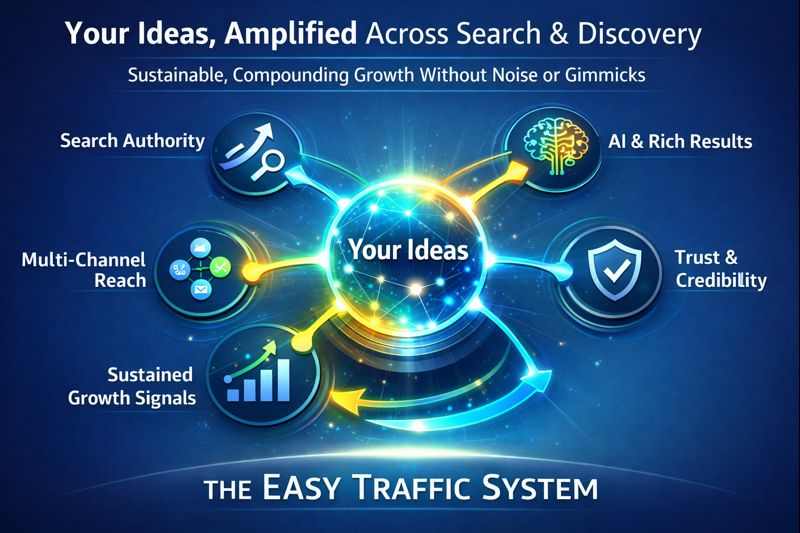
Table of Contents
- Mass Content Was Never the Real Strategy
- What Changed in Modern Search
- The Hidden Problem With Unstructured Publishing
- The Rise of Structured Content Velocity
- From Articles to Authority
- The Easy Traffic Systems Model
- The Bottom Line
- FAQ
Mass Content Was Never the Real Strategy
High-volume publishing worked in the past because it increased keyword reach and created more entry points into search results. Each new article was another opportunity to rank.
But the real reason those sites grew was not the quantity of content — it was the depth they accidentally created around specific subjects.
They were becoming topical authorities.
Modern search engines now measure that authority directly. Instead of rewarding isolated relevance, they reward complete subject coverage and strong content relationships.
What Changed in Modern Search
Search engines no longer evaluate a page as a standalone asset. They evaluate how that page fits into the larger context of your website.
First, topical authority became a primary ranking factor. Google is no longer asking whether a single page answers a question. It is asking whether your site is a trusted source on the entire subject.
Second, semantic understanding replaced simple keyword matching. Content is now evaluated based on how well it connects to related ideas, reinforces supporting topics, and builds a clear knowledge structure.
Third, AI-driven search prefers organized information. AI systems pull answers from sources that demonstrate clear hierarchies and deep expertise. Random articles do not provide that clarity. Structured topic clusters do.
The Hidden Problem With Unstructured Publishing
When content is published without a defined role, several issues appear over time.
Articles begin to compete against each other instead of working together. Important pages never gain strength because they are not supported. Internal linking becomes inconsistent. Traffic spikes briefly and then plateaus.
This is not a content problem. It is a structural problem.
Without a framework, even high-quality content cannot send a strong authority signal.
The Rise of Structured Content Velocity
The sites that dominate today are not publishing less content. In many cases, they are publishing more.
The difference is that every article is deployed with a purpose.
Pillar pages define the core topics. Supporting articles expand each subtopic. Internal links connect everything into a clear hierarchy.
This transforms content from a collection of posts into a unified ranking system.
The result is faster indexing, stronger primary rankings, and traffic that compounds instead of stagnates.
From Articles to Authority
Mass content alone is like placing building materials on a field. You have everything you need, but nothing is working together.
When content is clustered and structured, those same materials become a skyscraper.
Each supporting article strengthens the pillar. Each internal link reinforces context. Each new post increases the authority of the entire topic.
That is when growth shifts from linear to exponential.
The Easy Traffic Systems Model
At Easy Traffic Systems, content is never treated as an isolated activity.
Content creation, topic structure, internal linking, and schema validation work together as a single ranking framework.
This unified approach ensures that every article:
- Has a defined purpose
- Strengthens a primary topic
- Contributes to a measurable authority signal
Because modern search does not reward publishing volume alone — it rewards demonstrated expertise at scale.
The Bottom Line
Mass content still works.
But it only delivers long-term results when it builds topical authority.
The goal is no longer to publish more posts than your competitors.
The goal is to own more complete topics than they do.
Traffic now follows structure, depth, and clarity.
And when those elements are in place, every new article becomes a compounding traffic asset instead of another page in the archive.
FAQ
Is mass content still important for SEO?
Yes. Publishing consistently increases keyword coverage and topical depth. The difference is that content must now be strategically structured to build authority.
What is topical authority?
Topical authority is the level of trust search engines assign to your site based on how completely and clearly you cover a subject and how well your content is connected.
Why doesn’t random content scale traffic anymore?
Because search engines evaluate subject expertise across your entire site. Isolated posts do not create a strong authority signal.
Do topic clusters help rankings?
Yes. Clusters strengthen pillar pages, improve crawl efficiency, and create clear semantic relationships — all of which are major modern ranking factors.
Is this approach only for large sites?
No. In fact, structured content gives smaller sites a competitive advantage because it allows them to dominate specific topics faster.